Case Study
General Henry Champion House
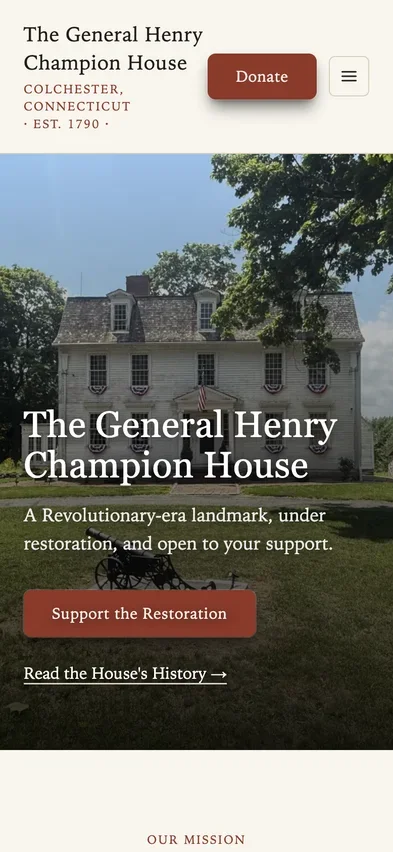
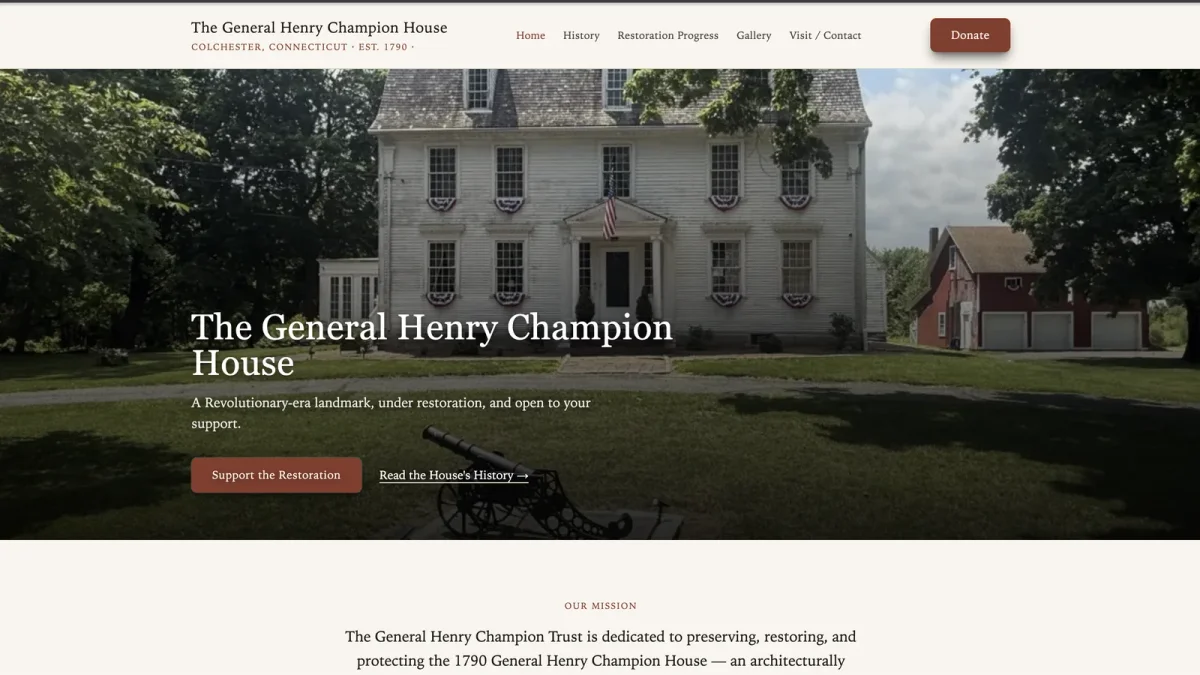
A custom Astro.js nonprofit website that took a newly-formed historic trust from a bare Wikipedia page to a fully live, donation-ready home for a rescued 1790 National Register landmark — six pages built and launched in about four weeks.
General Henry Champion Trust Colchester, CT
The Problem
When the General Henry Champion Trust formed in 2024, it inherited a genuine emergency dressed up as an opportunity. The 1790 General Henry Champion House — a Federal-period landmark on the National Register of Historic Places since 1972, and a stop on the Washington–Rochambeau Revolutionary Route — had sat vacant and deteriorating for years before landing at a court-ordered foreclosure auction in January 2024. The newly formed nonprofit trust stepped in to buy it and stop the sale.
That left the Trust with a rescued 1790 house, a restoration to fund, and a paperwork trail with a real discrepancy running through it. Beyond that, the organization had no web presence to speak of — a bare Wikipedia page was the only thing a search turned up. There was nowhere to tell the house’s two-Champion, Revolutionary War history, nowhere to show the restoration honestly as it happened, and — for a project entirely dependent on public generosity — no way to actually accept a donation.
The baseline told the story:
| What existed | Status |
|---|---|
| Website | None — Wikipedia page only |
| Donation mechanism | None |
| Documented history | Public sources only, not yet verified against primary records |
| Restoration transparency | None |
| Nonprofit paperwork | EIN discrepancy between the IRS letter and the state exemption certificate, unresolved |
The Proof
Roughly four weeks after the first research call, the Trust had a live, six-page site — Home, History, Restoration Progress, Gallery, Visit/Contact, and Donate — built for 12.4 billed hours, with a working donation platform behind it.
Performance, verified
Real PageSpeed Insights runs against the live site — not estimates. Desktop was strong out of the gate: 99 Performance, 100 Best Practices, 100 SEO, 91 Accessibility, with a 1.0-second Largest Contentful Paint. Mobile told a more useful story: an initial run flagged a 5.6-second mobile LCP, traced to a hero photo shipping far more resolution than a phone screen could use. Resizing and compressing that one image (754KB → 237KB) and telling the browser to prioritize it dropped mobile Performance from 78 to 94 and cut LCP to 3.0 seconds — verified with a second live PageSpeed run the same day, not just estimated.
What actually shipped
- A full photo library rebuilt for the web. Every client photo — HEIC and JPEG originals straight off a phone and camera — was converted to WebP and resized, cutting the site’s total image payload from 26.5MB to 4MB without losing the character of the real photography.
- A mobile performance bottleneck found and fixed with data. A live PageSpeed Insights run flagged a 5.6-second mobile LCP; resizing and compressing the homepage hero photo and prioritizing its load brought mobile Performance from 78 to 94 and LCP down to 3.0 seconds — confirmed with a follow-up run against the live site, the same day.
- A live donation platform, not a placeholder. A Givebutter campaign was built and refined, then wired in as a styled on-site button rather than an embedded third-party widget — so the Donate page stays fully on-brand while donors are handed off to a payment processor built for nonprofits.
- A corrected, primary-source history. The original draft copy had the house built for the wrong Champion’s marriage. A Colchester Historical Society document caught the error mid-build, and the entire “Built by…” section was rewritten before launch to reflect that Colonel Henry Champion built the house in 1790 for his own bride — not, as first drafted, for his son’s wedding.
- A paperwork error caught before it went public. The Trust’s IRS determination letter and its Connecticut tax-exemption certificate disagreed on the EIN by one digit. That got resolved and verified against the correct federal record before the number ever appeared on the live Donate page.
- An honest restoration record, not a highlight reel. When the client approved telling the 2024 foreclosure story publicly, that meant handling a real legal document with care — the attorney’s and prior owner’s names were blurred out of the auction sign photo before it went on the Restoration Progress page.
- Brand protection across every domain the client owns. henrychampionhouse.org was connected as the canonical live domain, and three other domains the founder had registered — henrychampion.com, henrychampion.org, and henrychampionhouse.com — were all 301-redirected into it, closing off brand confusion and squatting risk. (Redirecting one of them also surfaced an active legacy email configuration nobody had flagged — caught and handed back to the client rather than silently overwritten.)
Business outcomes
- A rescued landmark with somewhere to send people. Every historical society connection and every word-of-mouth mention now has a real destination that matches the seriousness of the preservation work.
- A donation ask that can actually be acted on. The Trust’s entire restoration plan depends on public support — the site now gives a visitor a direct, on-brand path to give, in place of no path at all.
- Built to be updated as the restoration continues. The Restoration Progress and Donate pages are written to be revised as milestones happen — “roofs underway” became “roofs now complete” the same week it became true, instead of sitting stale on the site.
Pending — Post-Launch Traffic Data
Search Console impressions, organic visits, and donation conversion data will be added here once the site has a full month of live traffic. The technical and content foundation is in place — the fundraising story is just getting started.
The Process
Research before a single page was built
Before any design work started, the project began with the property itself: the 1972 National Register nomination, the Trust’s IRS and state nonprofit documents, and the client’s own photos and mission-statement worksheet. That research surfaced the EIN discrepancy early, and later — once a Colchester Historical Society document arrived mid-build — it triggered a full rewrite of the History page’s founding narrative to match the primary source rather than the secondhand version.
Built on Astro 7, Tailwind CSS v4, and Cloudflare Workers
The site was scaffolded in Astro with the Cloudflare adapter and Tailwind v4, then built out as five core pages — Home, History, Restoration Progress, Visit/Contact, and Donate — sharing one layout, nav, and footer. A Gallery page with 24 curated photos from the client’s own Drive uploads followed shortly after. A click-to-enlarge lightbox lets visitors view any photo, from the foreclosure notice to the roof-repair crew shots, at full size.
Image pipeline
All of the client’s original photos — many of them HEIC files straight off a phone — were converted to WebP, resized for the web, and organized into descriptive filenames. The full image library dropped from 26.5MB to 4MB in the process, with zero loss to the photography that makes the restoration story feel real instead of generic.
Donation infrastructure
Givebutter was chosen as the processor: free to a verified 501(c)(3), nonprofit-friendly, and simple for the client to manage directly. Rather than embed Givebutter’s own widget — which would have broken the site’s custom Tailwind styling — the Donate page uses a plain styled button that opens the live campaign in a new tab, keeping full design control while still handing off payment processing to infrastructure built for it.
Domain and DNS cleanup
Once the primary domain was connected to the live Cloudflare Worker (apex and www both resolving), the same audit extended to three other domains the client had registered defensively. All three now 301-redirect, bare and www, to the canonical henrychampionhouse.org — protecting the brand from a squatted or confusing alternate domain, at no cost beyond domains the client already owned.
Catching what real users would feel
Rather than assume the build was done at launch, the live site got a real PageSpeed Insights pass on both desktop and mobile. Desktop came back excellent immediately; mobile flagged a 5.6-second Largest Contentful Paint, traced to a full-resolution hero photo shipping more pixels than a phone screen needed. Resizing it, recompressing it, and marking it as a load priority in the HTML fixed the bottleneck the same day — verified with a second live test, not just assumed fixed.
Built to grow with the restoration
The site went live mid-restoration, not after it — so copy throughout was written to be revised as physical work finished. When the house and barn both got new roofs the same week the site launched, the Donate and Restoration Progress pages were updated the same day to reflect it, instead of describing work that was already done as still “underway.”