Developer's Log
Social Media Is Not a Website
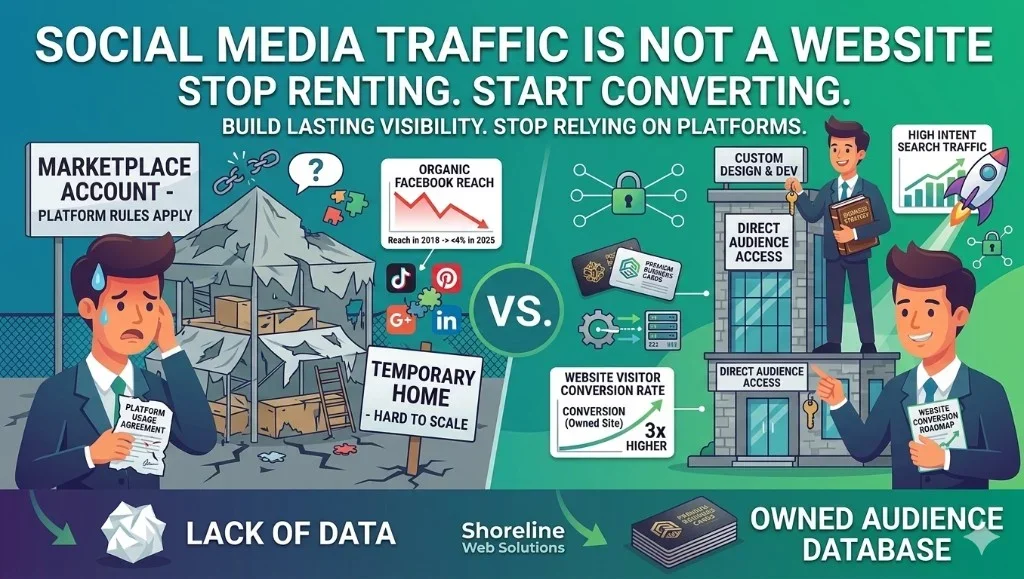
Social platforms are rented channels, not owned digital assets. This post explains why small businesses need a fast, search-optimized website they control.
And if your business is treating it like one, it’s probably costing you more than you think.
I’ve been working with small businesses for a long time. Before I built Shoreline Web Solutions, I ran a CrossFit gym for eight years and spent another eight years teaching Business and Marketing at Mitchell College. I’ve seen what makes businesses grow and what quietly holds them back.
One of the most common patterns I see is a business owner who has a solid reputation, great work, and happy customers. And a Facebook page. No website. Or a website so outdated and slow it might as well not exist.
They’re not lazy. They’re not careless. They just never got the memo that social media and a website are fundamentally different things.
This post is that memo.
You Don’t Own Your Social Media Presence
When I say social media is rented property, I mean it literally.
Your Facebook page doesn’t belong to you. Your Instagram following doesn’t belong to you. Every post you’ve published, every follower you’ve earned, every review you’ve collected - all of it sits on a platform owned by someone else.
And that someone else can change the rules whenever they want.
Accounts get hacked, suspended, or permanently banned with no warning and no real appeal process. Algorithms shift and suddenly your posts reach half the people they used to. The platform decides to prioritize paid content over organic content and your reach collapses overnight.
This isn’t a hypothetical. It’s been happening for years, and the data is clear.
The Numbers That Should Concern Every Small Business Owner
In 2012, when you posted something to your Facebook business page, it reached roughly 16% of your followers on average. Not great, but workable. Post to 500 followers and about 80 people would see it.
By 2025, that number has dropped to under 2%.
Post to 500 followers today and maybe 10 people see it. Unless you pay to boost it.
Instagram is not much better. Average organic reach has dropped from around 15% in 2020 to approximately 3% in 2025.
Your followers chose to follow you. The platform decided they should not see your posts unless you pay for the privilege.
This is not a bug. It is a business model.
(Sources: Hootsuite, Social Insider, Trust Insights)
Social Media and Websites Are Not the Same Thing
I want to clear up a distinction that gets blurred constantly, even by people who should know better.
Web design is how a website looks. The colors, the fonts, the layout, the visual experience a visitor sees.
Web development is how a website works. The code underneath, the speed, how Google reads it, how it performs on a phone, how it converts visitors into customers.
You can have a beautiful website that is a complete disaster under the hood. Slow to load, invisible to search engines, losing potential customers every single day. Most business owners would never know because it looks fine on the surface.
Social media is neither of these things. It is a distribution channel, not a digital presence. There is a difference, and it is an important one.
The Intent Gap: Why Website Visitors Convert at 3x the Rate
Here is something that gets overlooked in the social media vs. website conversation.
The people who find you on social media and the people who find you through Google are in completely different mindsets.
Social media users are scrolling. They are passive, distracted, half-watching a video and half-reading captions. They might like your post and keep moving. They were not looking for you. You interrupted them.
Website visitors are searching. They typed something into Google, looked at the results, and clicked your link. They came to you with a specific question or need. They are ready to engage.
This difference shows up directly in conversion rates. Research from ContentSquare, Ruler Analytics, and Red Stag consistently shows that website visitors convert at roughly 3 times the rate of social media followers. Organic social media marketing converts at around 1%. Paid social is even lower.
The reason is simple. Intent converts. Interruption does not.
The Generation Gap Nobody Is Talking About
I am 48 years old. I grew up without a smartphone. I did not have a social media account until I was well into adulthood.
And even I judge a business by its website before I ever pick up the phone.
When someone recommends a contractor or service provider to me, the first thing I do is look them up. If there is no website, or the website is slow and looks like it was built in 2009, I notice. It creates doubt, even when the recommendation came from someone I trust completely.
Now think about your customers who are 25, 30, or 35 years old.
They grew up entirely online. For them, a digital presence is not a second opinion. It is the first impression. They are not going to cut you slack for a bad website or give you the benefit of the doubt because you have good reviews on Facebook. They are going to keep scrolling until they find someone whose online presence matches the quality of their work.
You will not know they were ever there.
Algorithm Dependency: You Do Not Control Your Own Reach
One of the most underappreciated problems with relying on social media as your primary online presence is that your reach is entirely controlled by someone else.
It does not matter how good your content is. It does not matter how engaged your followers are. The platform decides, based on its own business interests, how many people see what you post on any given day.
Good SEO does not work like that.
When someone in your area Googles “electrician near me” or “dog trainer in Groton” or “web developer Old Lyme CT,” and your website is properly optimized, you show up. Consistently. Not because you paid to boost a post that day. Not because the algorithm was in a good mood. Because your site is built to be found.
Social media captures attention. SEO captures intent. Nobody Googles a problem and lands on a Facebook post.
The Modern Business Card
Think about paper business cards for a second.
Back when handing someone a card was the standard way to make a professional introduction, you could tell everything you needed to know the moment it landed in your hand. Thin, flimsy card stock with a clip art logo printed at home versus a thick, well-designed card with clean typography and a proper layout. Same information on both. Completely different message about the person handing it to you.
Nobody had to explain the difference. You felt it.
Your website is the modern version of that moment. Someone lands on it and within seconds they have already formed an opinion about your business. Slow load time, outdated design, missing contact information, photos that look like they were taken on a flip phone - that is the flimsy card. Fast, clean, professional, easy to navigate, built to answer the questions a potential customer actually has - that is the thick card stock with the embossed logo.
What makes this analogy even more relevant today is the scale. A paper business card was a single moment between two people. Your website is that moment happening over and over, at any hour, for every person who looks you up. It is working when you are on a job site, when you are asleep, when you are on vacation. And it is making an impression whether you know it or not.
The question is whether that impression is the one you want to be making.
The Credibility Signal You Are Missing
There is a softer argument that I think is actually the most important one.
Your website is a direct reflection of how seriously you take your business.
There is an old military saying: how you do something is how you do everything. I have found that to be true for small business owners and their digital presence. The contractors and service providers who have a fast, professional, well-built website tend to take everything seriously. Their work, their communication, their follow-through.
And buyers pick up on this before they ever make contact.
A professional website tells a potential customer that you invest in your business. That you are not going anywhere. That you care about how you are perceived. It signals permanence and credibility in a way that a Facebook page simply cannot.
Higher-ticket buyers especially are looking for these signals. They are not hiring the cheapest option. They are hiring the option they trust. And trust is built, in part, by what they find when they look you up.
What a Proper Website Actually Does For You
Let me be direct about what I mean when I talk about a “proper” website, because not all websites are created equal.
A proper website is one you own outright. No monthly platform fees, no dependency on a subscription service that can change its pricing or shut down. The code belongs to you.
A proper website is fast. PageSpeed scores in the 90s and 100s. Pages that load in under two seconds on a phone. This matters because Google uses speed as a ranking factor, and because users abandon slow websites instantly.
A proper website is built to be found. Structured data tells Google exactly what your business is, where you are located, and what services you offer. Local SEO puts you in front of people searching in your area at the exact moment they need what you do.
A proper website converts. It is designed with a clear path from visitor to inquiry. It does not just exist on the internet. It works.
And a proper website works while you sleep. It generates leads, answers questions, and builds credibility 24 hours a day, seven days a week, whether you are on a job site or on vacation. It does not require you to post consistently to stay visible.
What This Looks Like in Practice: Martel Electric
Jeremy Martel runs Martel Electric LLC out of Plainville, Connecticut. When I first connected with him, his business was running almost entirely on social media and referrals. He had a basic Bootstrap site that functioned as a placeholder. No SEO. No structured data. Invisible to Google.
Here is what his site looked like before we rebuilt it:
| Metric | Before |
|---|---|
| Mobile PageSpeed Score | 68 |
| Mobile LCP (how long the page took to load on a phone) | 64.5 seconds |
| SEO Score | 91 |
| Structured Data Schemas | 0 |
A 64.5-second load time on mobile. In a world where users expect pages to load in under 3 seconds and will leave after 3. That number is not a typo.
After a full custom rebuild on Astro, Tailwind v4, and Cloudflare Pages:
| Metric | After |
|---|---|
| Mobile PageSpeed Score | 98 |
| Mobile LCP | Under 4 seconds |
| SEO Score | 100 |
| Structured Data Schemas | 6 |
That is not a redesign. That is a transformation. Jeremy went from a business invisible to search engines to one that shows up when people in his area need an electrician.
The quality of his work did not change. His website finally started reflecting how good that work actually is.
Whether You Hire Me or Not
I want to be direct about something.
This post is not a pitch for Shoreline Web Solutions.
There are good web developers out there. If you have one you trust, work with them. If you want a starting point, get in touch and I’ll give you a plain English breakdown of your PageSpeed score, Core Web Vitals, local SEO gaps, and structured data. No jargon. No obligation.
But more than anything, I want small businesses to stop treating social media like a substitute for a real digital presence. Too many good businesses are leaving leads on the table and losing customers they never knew they had because their online presence does not match the quality of what they actually do.
There are too many mediocre businesses out there. They make customers skeptical of all of us. The good ones, the ones who do great work and treat their customers right, deserve a digital presence that says so before anyone ever picks up the phone.
Your website is the one piece of digital real estate you actually own.
Stop renting. Start owning.
Direct: (860) 222-1444
Randy Tarasevich
Founder, Shoreline Web Solutions
Randy is a web developer, business educator, and founder of Shoreline Web Solutions — a custom web development studio based in Old Lyme, CT. He has spent four years building performance-first websites for small businesses using Astro.js, Tailwind CSS, and Cloudflare Workers, and previously taught business courses at the college level for eight years.