Why Your Small Business Needs More Than Just a Social Media Page: The Critical Case for a Professional Website
R
By Randy Tarasevich
Author
Published
10 min read
When Martel Electric LLC first came to us, they were a legitimate, established electrical contracting business operating in Connecticut with zero web presence beyond a Facebook business page and a Google Business listing on Google Maps. No website. No owned digital presence. While the Google Maps listing helped them show up in local searches, it gave potential customers almost nothing to go on. No service details, no credibility signals, and no way to convert interest into action.
It’s a story we’ve seen play out more times than we can count. A skilled, reputable business doing great work in the community, but invisible to the majority of customers who search Google when they need an electrician. The Facebook page looked fine. However, it wasn’t doing what a real digital presence needs to do which is to establish credibility, show up in search results, and convert visitors into customers. After a few conversations with the owner about how we could improve his business’s online presence, we built Martel Electric a professional, hosted business website. Just like that they had a digital presence they actually owned and that could be found, trusted, and acted on. Their story isn’t unique. It’s the rule, not the exception.
Across Connecticut’s small business community, we regularly encounter passionate entrepreneurs who have poured everything into building a great business, but have inadvertently limited their growth potential by anchoring their entire digital strategy to platforms they don’t own or control. A Facebook page, an Instagram account, or a TikTok profile are all free, easy to set up, and offer immediate visibility. It’s an understandable starting point, but it’s not a destination.
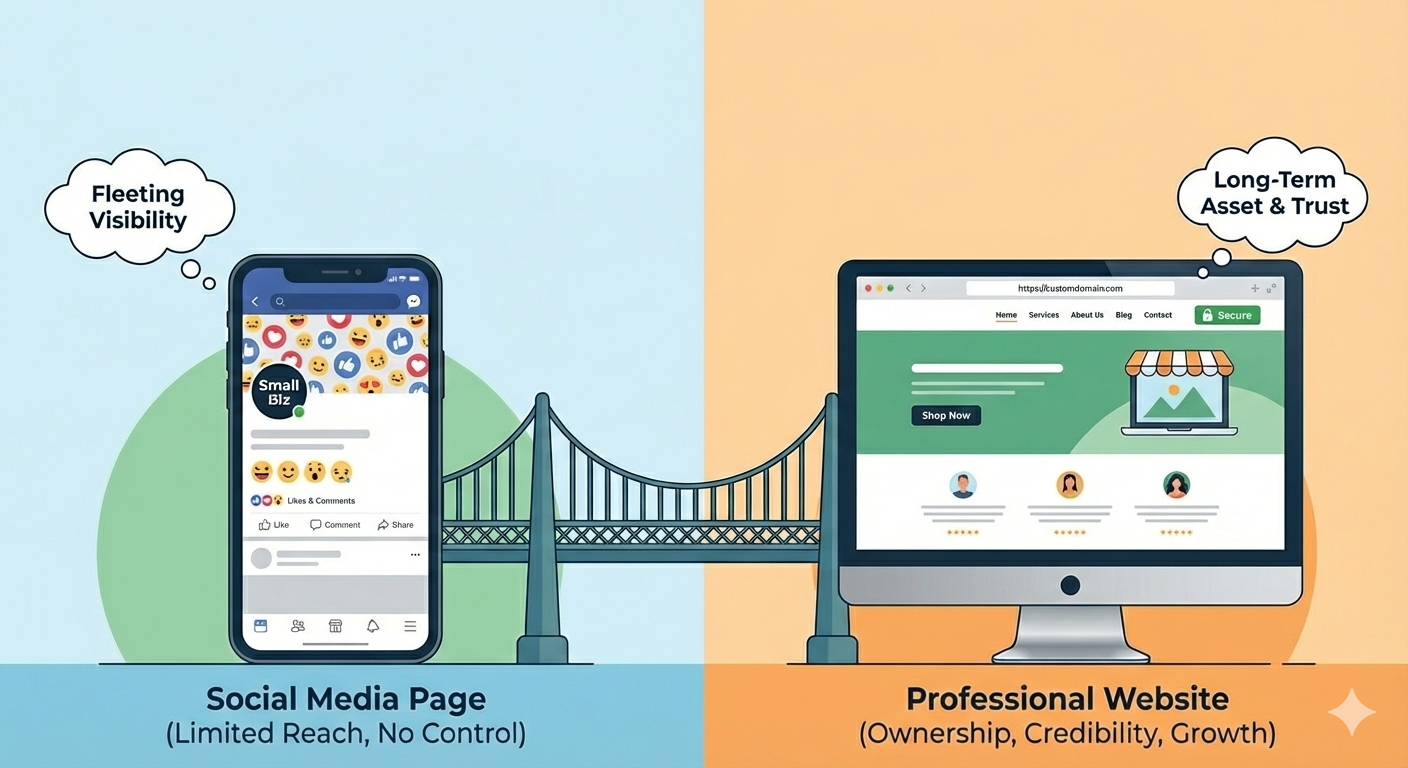
Relying solely on social media for your business’s digital presence is like building your house on rented land. You may enjoy the benefits for a while, but you have no real ownership, no real control, and no long-term security. These business owners often express frustration with inconsistent results, difficulty reaching their target audience, and an inability to convert social media engagement into actual sales. The solution isn’t to abandon social media. It’s to understand its proper role within a comprehensive digital strategy — one that has a professional website as its foundation.
The statistics paint a clear picture. While 73% of small businesses had a website in 2022 (up from just 55% in 2017), a significant number of businesses still haven’t made this critical transition. That gap represents both a missed opportunity and a real competitive disadvantage. Businesses that have invested in professional websites consistently outperform their social-media-only competitors in customer acquisition, revenue growth, market credibility, and long-term sustainability. The question isn’t whether your business needs a website. It’s how quickly you can get one deployed so that you customers find you easier.
The Trust and Credibility Factor
First impressions in business are everything and in our digital age, that first impression is almost always formed online. Research consistently shows that 94% of first impressions are shaped by how a website looks, and 75% of consumers judge a business’s credibility based on its website. That credibility assessment happens within seconds, and the difference between a professional website and a social media profile can determine whether a potential customer engages with your business or moves on to a competitor.
When consumers research businesses, which 81% of shoppers do before making a purchase, they expect to find a professional website that provides comprehensive information about your services, your credentials, and your business. A social media profile alone signals that you may be operating on a smaller scale, less established, or without the resources to maintain a professional online presence. Whether or not that’s true, the perception directly impacts whether people trust you with their business.
The trust problem runs deeper than perception alone. According to the 2024 Thales Digital Trust Index, a global survey of 12,000 consumers across 14 countries, only 6% of people trust social media companies with their personal data. That’s the lowest of any industry measured, including media and entertainment. When potential customers evaluate your business on a platform they fundamentally distrust, that distrust has nowhere to go but toward you. A professional website operates independently of any platform’s reputation or baggage. It lets you build trust entirely on your own merits.
You Don’t Own Your Social Media Presence
This is the most critical vulnerability of any social-media-only strategy: you don’t own it.
When you build your business presence exclusively on platforms you don’t control, you’re renting digital real estate. That arrangement might seem convenient in the short term, but it creates risks that can devastate your business overnight. Accounts can be suspended, hacked, or banned without warning and when that happens, you have no recourse, no backup plan, and no alternative way to reach your customers.
Beyond account security, consider these ongoing platform dependencies:
Algorithm Control. Social platforms are built to serve their users, not your business. Organic reach has declined significantly across most major platforms over the years, forcing businesses to pay for visibility they once had for free. Your content may not reach even your own followers without a paid boost.
Changing Rules. Platform policies change constantly. What works today might be penalized tomorrow. Businesses that build their entire digital strategy around one platform’s rules are always one policy update away from a major disruption.
Platform Instability. Platforms rise and fall. Remember Vine? Google+? MySpace? Even dominant platforms face regulatory pressure, declining user bases, and cultural shifts. Building your business on any single platform is a risk no owner should take lightly.
With a website, you own your presence outright. No algorithm can hide it. No policy change can take it away. No platform decline can make it disappear.
Search Engine Visibility and Long-Term Growth
Here’s a reality many business owners overlook: when people search for local services, they’re using Google — not a social media platform. Search engines drive more website traffic than social media, and businesses without websites are simply invisible to that traffic.
SEO Benefits. A website allows you to optimize for the searches your potential customers are actually making — “web design Old Lyme CT,” “electrician near me,” “catering company Connecticut.” Local SEO lets your business appear in results with your location, hours, ratings, and services displayed prominently.
Content Longevity. Social media posts have a lifespan measured in hours. A well-written blog post or service page, by contrast, can attract customers for years. The content you invest in today keeps working for you long after it’s published.
Compound Growth. SEO is one of the few marketing channels that improves over time. The more quality content and links your site accumulates, the more visible you become — a compounding return on your investment.
Control Over Customer Experience and Data
Social platforms dictate how your business looks and functions. Every profile follows a template. You can change your cover photo and your bio, but you can’t change the structure, the layout, or the user experience. You can’t design a customer journey. You can’t control what ads your competitors run next to your content.
With a website, you control everything:
Most importantly, you own the data. When customers interact with your website — signing up for email lists, submitting contact forms, making purchases — that information belongs to you. It helps you understand your customers, improve your marketing, and build a business that isn’t dependent on any third party to reach its own audience.
The Revenue Impact
The financial case for a professional website is compelling. Small businesses typically see 15–50% revenue growth when they actively use their websites to engage with customers. Additionally, 97% of customers say a business’s website influences their purchase decisions, and 91% of customers have visited a physical location after first interacting with that business’s website.
For Connecticut’s service-based economy, this local connection is especially powerful. When someone searches “plumber near me” or “restaurant in Old Saybrook,” businesses with optimized websites appear in the results. Businesses without websites don’t exist in that search — no matter how great their social media presence is.
Social Media Still Matters — But As Part of a Larger Strategy
Nothing in this article is an argument against social media. Quite the opposite — it’s one of the most valuable tools in a small business’s marketing arsenal. The key is understanding its role. Social media is where you engage, build community, show personality, and drive awareness. Your website is where you convert that awareness into real business. Together, they form a digital presence that is both discoverable and trustworthy.
Best Practice: Use social media to engage with your audience and drive traffic to your website — where you control the experience, capture the lead, and complete the transaction on your own terms.
The integration looks like this:
Each social post becomes a bridge, not a destination.
Connecticut-Specific Considerations
Connecticut customers expect professionalism and reliability. That expectation extends to your digital presence. A business with a polished, informative website signals to local customers that you’re established, serious, and invested in the community you serve. Local SEO strategies can help Connecticut businesses capture searches for regional terms and connect with customers in their geographic area — something a social media profile simply cannot replicate.
The Path Forward
The most successful small businesses aren’t choosing between websites and social media — they’re using both strategically.
Your website is your business headquarters: the authoritative, always-on source of information about who you are, what you do, and how to engage with you. It captures leads, enables transactions, and builds credibility around the clock. Your social media presence is your outreach engine: it builds awareness, shows personality, and drives traffic back to your home base. Integrated together, they form a digital strategy that compounds in value over time.
Taking Action
If your business currently relies solely on social media for its digital presence, this is your moment to change that.
The bottom line is simple: a social media profile is an excellent marketing tool, but it is not a substitute for a professional website. In today’s competitive marketplace, businesses need both to thrive. A website provides the foundation of credibility, ownership, and searchability that no social platform can offer — while social media provides the engagement and outreach that drives customers to your door. Don’t build your business on rented digital land. Invest in a presence you own and control, then use social media to amplify its reach. Your future customers — and your bottom line — will thank you.
Sources and References
Shoreline Web Solutions helps small and medium-sized businesses in Connecticut establish complete, professional digital presences — from custom websites to branded email and beyond. Contact us to talk about building a web presence you actually own.
Web Developer
Web developer helping businesses grow online with professional websites and web applications.
Let's discuss how we can help bring your vision to life with a website that truly represents your business.